For most of my life, toile de Jouy was the kind of print you noticed without naming. It lived on the porcelain plates surrounding my grandmother’s kitchen door, on the slightly faded armchair in aunt Yolanda’s house in Caracas, and on the wallpaper of my dad’s friend’s guest room in Cantabria that always smelled of bergamot. It belonged to a generation that wasn’t mine and I never really thought about it.
Then in 2019, Maria Grazia Chiuri sent it down a Dior runway, and a print considered classic became the staple my generation suddenly decided was cool. Pinterest boards filled overnight with bedrooms covered in toile, wallpapers and dresses followed, and the Dior Book Tote in toile de Jouy started showing up on every It-girl’s shoulder. Nothing about the fabric had changed dramatically so how did it travel through time to become relevant again?
That question sent me down a years-long detour through museum archives in London, conversations with antique dealers, and late nights in a rabbit hole reading textile history that has a low fan count. That's the thing about hyperfixation in 2026: research has never been easier than it is now, and you can spend short, intense bursts exhausting a single topic until you feel intellectually satisfied. Which is exactly what happened when I onboarded this print, with the same focused passion a British birder reserves for finally spotting a kingfisher.

The Thread Pulling the Story
Toile de Jouy is, on paper, a French textile invented in 1760 by Christophe-Philippe Oberkampf, a young German entrepreneur who opened a printing factory in the village of Jouy-en-Josas, four kilometres from Versailles. That is what every reference book will tell you, and technically it’s true. But the chain of events that made it possible, though, stretches back almost a thousand years and crosses six cultures before it arrives anywhere near France.
The cobalt blue ink that became its signature was being mined in ninth-century Persia, specifically in the Kashan region of what is now Iran, where it was so scarce and precious it was reserved for palaces and diplomatic gifts between rulers only.

Persian merchants carried that cobalt east along the Silk Road around that time and approached the potters of Tang dynasty China with a very specific request: apply this pigment to your fine white porcelain. The result is what we now call “blue and white porcelain”.
The genuinely funny part is that the Chinese considered the finished product vulgar, far too ornate for imperial taste, which preferred a quieter celadon green. They made it almost exclusively for export and by the Yuan dynasty in the 14th century, this loop had tightened into something almost fantastical: Chinese potters in Jingdezhen were painting Arabic inscriptions onto Persian-funded ceramics without being able to read a single character of what they were copying.

If this sounds invented, the receipts are still on display in Istanbul. The Topkapi Palace holds over 12,000 pieces of Chinese porcelain accumulated over four centuries by Ottoman sultans, including the largest collection of celadon in the world and more than 5,000 pieces of blue and white: an entire empire’s obsession, catalogued and preserved.

When this blue and white porcelain reached Europe in the 17th century, the continent went into a buying frenzy. European royalty traded estates for cabinets full of porcelain, and Augustus II of Saxony famously swapped 600 of his Saxon dragoon soldiers to the King of Prussia for 151 Chinese vases.
Nobody on the continent could figure out how to make porcelain (the formula remained a Chinese secret until Meissen finally cracked it in 1710), so Europeans did what they always do with things they cannot have: they invented their own version and Chinoiserie was born, a European aesthetic movement that translated the imagery arriving on Chinese ships, pagodas and mountains and rivers and figures in silk robes, into wallpapers, furniture and porcelain copies.
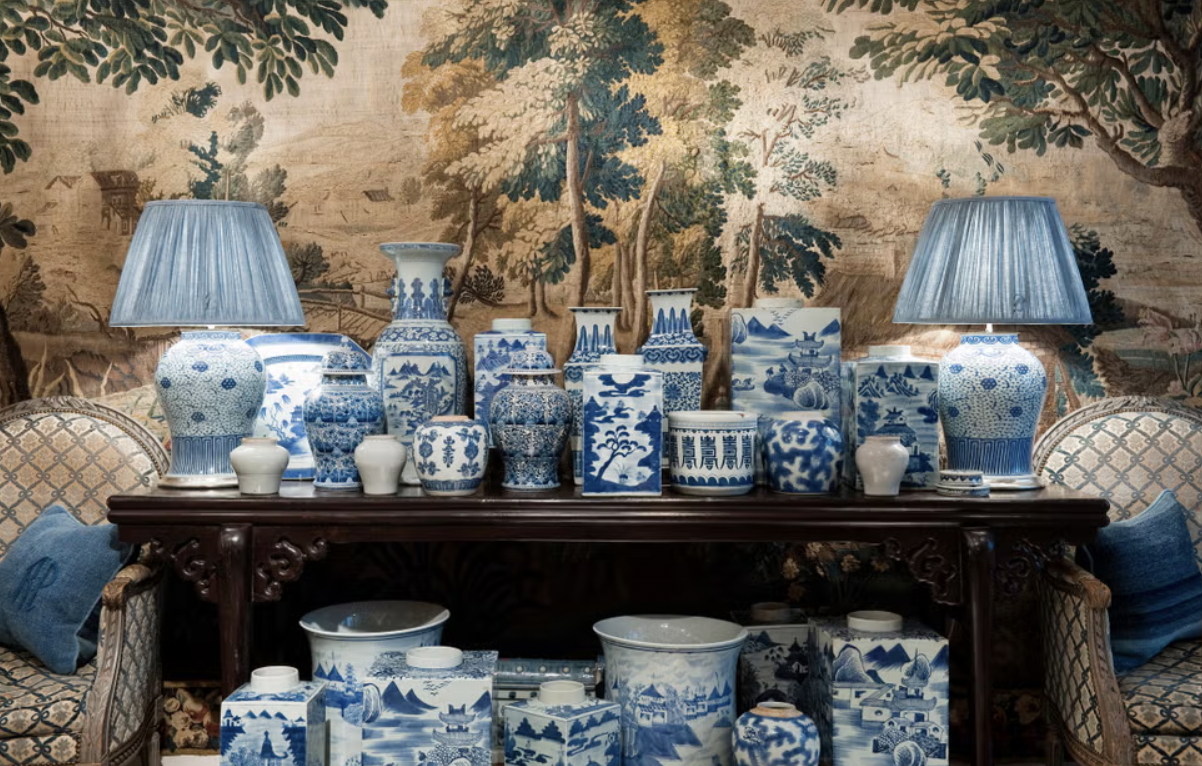
None of it was particularly accurate, and it was never meant to be, it was simply Europe’s fantasy of China, projected onto every available craft. Edward Said would later call this kind of construction Orientalism: the West inventing the East to satisfy its own appetite.
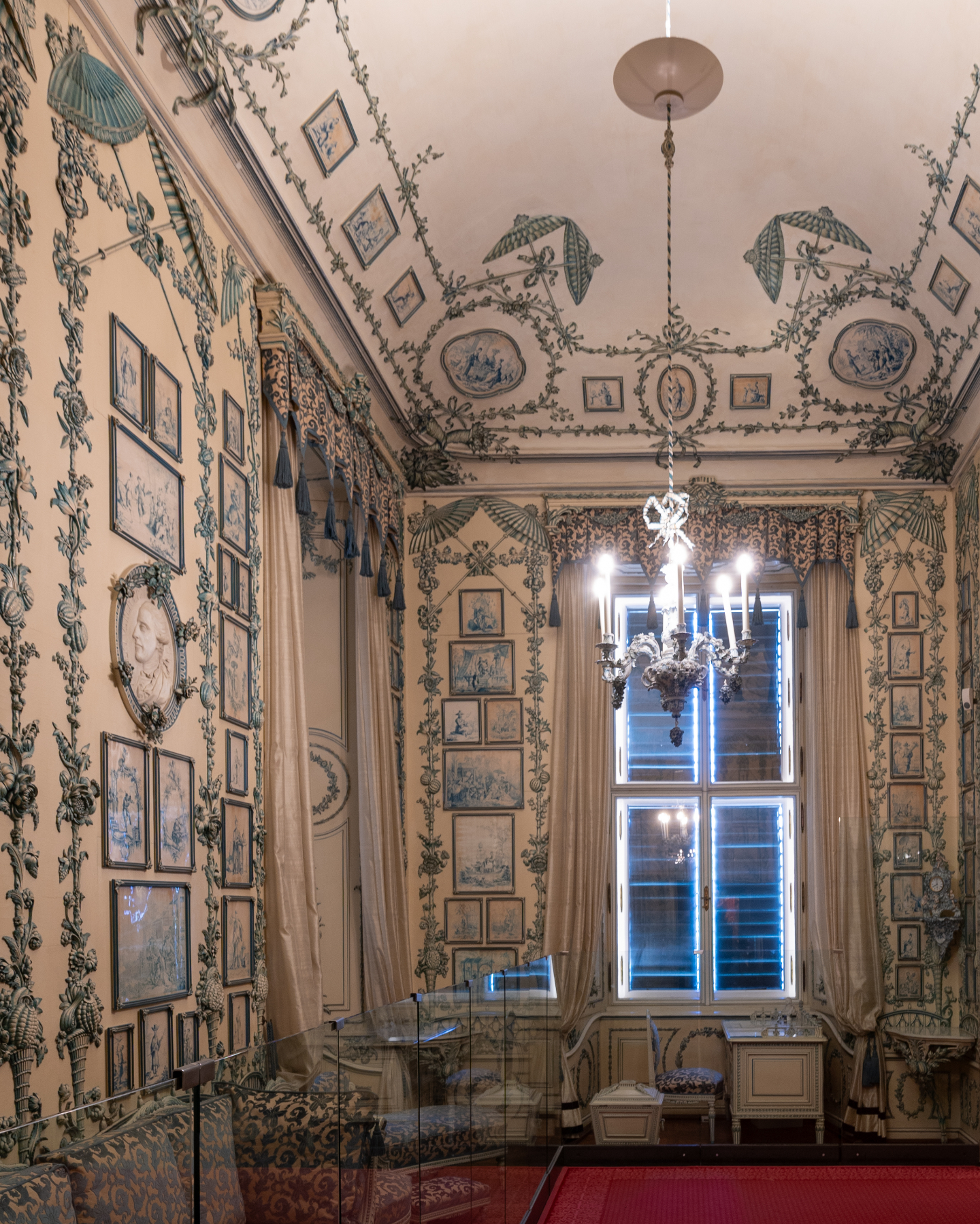
You can still walk through these fantasies if you know where to look. The Chinese House at Sanssouci in Potsdam, commissioned in 1755 by Frederick the Great, with gilded life-sized figures of imaginary Chinese musicians dressed in fairytale clothing. The Chinese Pavilion at Drottningholm, presented in 1753 as a birthday gift from the King of Sweden to his queen. The Porcelain Room at Schönbrunn in Vienna, decorated in 1763 for Maria Theresa with paintings done by her own husband and children. These rooms were never trying to be subtle or accurate.
And while Europe was busy building imaginary Chinese palaces, the East India Company was bringing something genuinely new from India: indiennes, hand block-printed cotton in vivid colours nobody in Europe had seen before. The fabric was lightweight, washable, affordable, and very quickly threatening the wool and silk industries that France depended on. In 1686, Louis XIV banned it outright and it lasted over seventy years. A black market flourished quietly throughout, and when it was finally lifted in 1759, demand erupted overnight.
The Aristocratic Fantasy of Rural Life
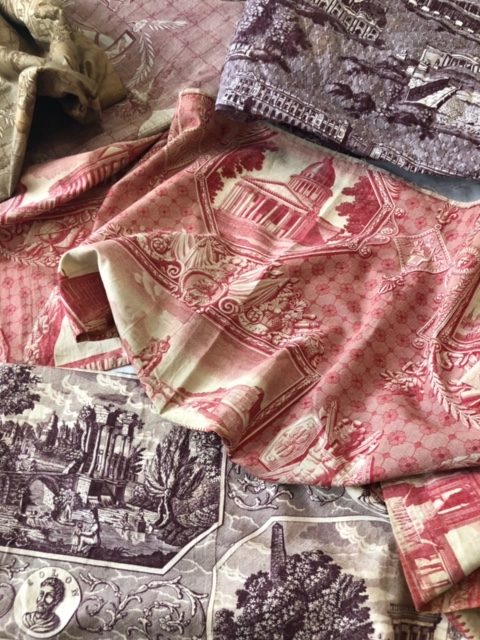
Oberkampf opened his factory in 1760, adopted a copper plate engraving technique pioneered in Ireland in the 1750s (the only way to print fine, detailed scenes onto fabric), and used the imported Indian printing method to give Europe a version of what chinoiserie had quietly become: a visual language Europe built on monochrome narrative scenes printed across a textile, blue on white, like the Chinese porcelain that had obsessed the continent for a century.
The difference was the imagery itself. Where chinoiserie filled those scenes with imagined Chinese life, Oberkampf filled them with pastoral French ones. This last part matters more than people usually acknowledge, or at least I would like to have a more pointed conversation about it, because this is the move that turns a piece of fabric into a storytelling vessel.
By the mid-18th century, the European aristocracy had developed a deep romance with the idea of rural life, fuelled by Enlightenment writers like Rousseau who argued that civilization had corrupted humanity and that simple country existence held some kind of moral purity.
Painters like Boucher and Fragonard built entire careers on idealised scenes of shepherdesses, picnics, garden swings and amorous countryside flirtations. None of this had much to do with actual peasant life, which was largely brutal, hungry and short-lived. It was a fantasy curated and designed by and for people who had never milked a cow.
Marie Antoinette is the patron saint of this contradiction. After Louis XVI gave her the Petit Trianon in 1774, she spent years transforming the grounds, and between 1783 and 1787 she built the Hameau de la Reine, a working farm with cottages, a dairy, a mill and animals, all done in idealized Norman rustic style.
The cottages had thatched roofs on the outside and elegant aristocratic furniture inside. She hired a professional farmer named Valy Bussard to actually run the operation, while she and her ladies took private walks, hosted suppers and performed countryside without any of its inconveniences.
When she visited Oberkampf’s factory in 1781, she fell for the fabric immediately, because he was essentially selling her own daydream back to her in cotton: the pastoral scenes that decorated her private retreat, now wearable. Oberkampf received the title of Royal Manufacturer in 1783, and the factory rapidly became the third largest industry in France. The last fabric Marie Antoinette is recorded buying before her execution was a pink toile de Jouy dress, ordered from prison.
From Versailles, the print travelled outward, to the British colonies, the American colonies and the French Caribbean, where pastoral scenes were printed onto cotton and hung inside plantation houses built on enslaved labour, often the very labour that grew the cotton itself. Literally a pastoral fantasy printed on cotton harvested by the people the fantasy was carefully editing out.
This is the part of toile's history that takes longer to find in design books, but contemporary artists have been quietly rebuilding it. Sheila Bridges has been making her Harlem Toile de Jouy since 2006, replacing French shepherds with scenes of contemporary Black American life.
In 2022, the Haitian-American designer Victor Glemaud collaborated with Schumacher on Toussaint Toile, which swaps Versailles picnickers for portraits of Toussaint Louverture, the formerly enslaved general who founded Haiti by defeating Napoleon's army, set in uniform among Haitian mountains, palm trees, hibiscus and the Hispaniolan trogon. The V&A's Marie Antoinette’s exhibition this year closed on works like these, which is, structurally, the only honest way to tell a 250-year-old story: with the pastoral form finally turned against itself.
1947, and the Print That Wouldn’t Leave
When Christian Dior opened his couture house at 30 Avenue Montaigne in 1947, the war had just ended and post-war women, in his view, needed grace returned to them after years of military austerity.

His friend, the painter Christian Bérard, suggested using toile de Jouy to upholster the small ground-floor boutique Dior had named Colifichets (“trinkets”). The specific print Bérard chose was a reissue of Jean-Baptiste Huet’s L’Escarpolette, a toile that itself reproduced Fragonard’s 1767 painting Les Hasards Heureux de l’Escarpolette: a young woman on a garden swing being pushed by her unsuspecting husband while her lover hides in the bushes.
So at the moment Dior opened his doors, the founding fabric of the house was already four layers of cultural reference deep, a Rococo painting copied into a Huet toile, reissued in the 20th century, applied to a boutique trying to bring beauty back after WWII.
The print has lived inside the house ever since, which is partly why Chiuri’s 2019 collection launch felt less like a revival and more like a homecoming.
The Prime Mover of Taste
What has kept me thinking, long after I put a big part of the puzzle together, is that nothing about the print itself ever really changed. The colour palette Oberkampf set in 1760 is the same Dior used in 1947 and the same Chiuri put on a runway in 2019. Everything around it, however, has been in constant motion: the cultural moment, the people doing the wanting and the rooms it gets placed in. It feels like taste works less like a forward march of invention and more like a long memory that gets reactivated by whoever has enough cultural authority to remind us a thing exists.
The toile is, in that sense, quite an optimistic story about human creative capacity. Over a thousand years a Persian miner, a Tang dynasty potter, an Arab merchant, a German entrepreneur and an Austrian queen each contributed something to an object none of them would ever see finished, and the object still feels inevitable. That happened because human beings have, across deeply different cultures and time periods, the appetite for combining things, the patience to refine them, and the agency to decide what gets carried forward.
Algorithms will not replace any of this. Algorithms do not think, and so they cannot be tastemakers. They are tools that respond to whoever programs them and whoever runs them, and the agendas behind them are always human.
What worries me isn’t being replaced in the cultural industries, it’s us forgetting that the work of carrying things forward across centuries and of letting something sleep for fifty years and then reactivating it with knowledge intact, is a deeply human practice that has always required attention, patience and exposure to things that are most definitely outside our immediate feed.
If we want the next toile de Jouy to exist, we have to keep doing the thing that made the first one possible: reading, travelling, going into the rooms where the porcelain is, learning the inscriptions we cannot read, and putting them next to fabrics we’ve never seen before.
Potentially, the algorithm can help us do this if we use it the right way. It can surface dormant aesthetics, connect us to objects we would never have encountered, make research that used to take years happen in months - fueled by the hyperfixation that brought me here in the first place, because at the end of the day what it cannot really, really do, is decide for me what I like.
The print has been patient all this time, stayed on the loop; the question I want to pose now is whether we will keep showing up, with autonomy, to make sure the next thousand-year story has fertile human ground to start growing from.
This blog was written by Valeria Reglá of The Cult Edit. For more thought-provoking articles on design, culture, fashion, and visual history, visit her website: https://readthecultedit.substack.com/